The Government Committee for Religious Affairs (GCRA) chaired on December 2 a scientific seminar themed "Situation of Tantric Buddhism's activities in Vietnam and several recommendations ".
Speaking at the seminar, Vice Chairwoman of the GCRA Trần Thị Minh Nga stated that Tantric Buddhism has had certain influences on Vietnamese spiritual culture. However, the management of this Buddhist sect currently present many challenges.
Up to now, there have been many research works on Buddhism and the state management of Buddhist activities. However, there has not been a study that comprehensively evaluates the situation and activities of Tantric Buddhism, its characteristics, and its influence on social life in Vietnam. This has led to many people being interested in Tantric Buddhism but having very little understanding and lacking access to honest and objective information.

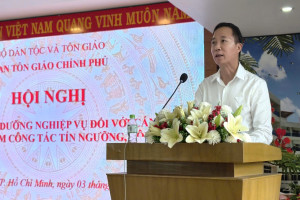
Participants at the seminar
The seminar focused on exchanging information, discussing, and clarifying issues on:
(1) History of the introduction and development of Tantric Buddhism in Vietnam: An overview of the introduction of Tantric Buddhism to Vietnam through different periods (for example, from India, China, Tibet...) and the interaction with traditional Zen and Pure Land Buddhism.
(2) The current state of Tantric Buddhism activities in Vietnam: the number of monasteries, ashrams, monks and nuns, and lay Buddhists; the presence of Tibetan Tantric Buddhism (Tibet), Eastern Tantric Buddhism (Japan, China), and Vietnamese Tantric Buddhism; the practical contributions of Tantric ashrams in social charity, cultural preservation, and guidance for lay Buddhists to live a virtuous life and practice the Dharma.
(3) Some issues that need attention: The phenomenon of impersonating Tantric Buddhism for personal gain, superstition, or spreading unorthodox teachings, which negatively affects the image of Buddhism; difficulties in the management of the Vietnam Buddhist Sangha regarding Tantric monasteries and followers; some Tantric practitioners have not received proper training, lack verification of qualifications and precepts; many Buddhist followers have a wrong understanding of Tantric Buddhism, focusing solely on the mystical and praying aspects while neglecting the element of enlightenment.
(4) Recommendations and solutions to enhance the effectiveness of state management regarding the activities of Tantric Buddhism in Vietnam today.
Tantric Buddhism, also known as Esoteric Buddhism, Mantrayana, Vajrayana, Fruition Buddhism... is one of the sects of Buddhism formed in India around the 7th century AD; later spread to Tibet, China, Japan, Korea... and especially developed in Tibet.
In Vietnam, the term Vajrayana is often used to refer to Tantric Buddhism. Tantric Buddhism was introduced in the 5th century by the Indian monk Vinitaruci, who came to Vietnam and translated the Mahayana Mahaparinirvana Sutra (a sutra of Tantric Buddhism).
Although it was introduced to Vietnam early, it was not until 1992 that Tantric Buddhism became widely known and gained interest, due to the teachings of the late Most Venerable Thích Viên Thành - Abbot of Huong Pagoda, who went to Bhutan to receive teachings from the Dharma Master of this country belonging to the Drukpa lineage.
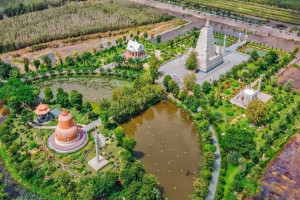
There are currently a number of pagodas in Vietnam bearing the clear mark of Tantric Buddhism, such as: Tay Thien Pagoda located in Phu Tho province, Long Quang Pagoda located in Hanoi city, Khuong Viet Pagoda located in Ho Chi Minh City, etc.
Linh Nguyen