The Law on Belief and Religion (hereinafter referred to as the Law) was passed on November 18, 2016, during the 14th National Assembly’s 2nd session, and took effect on January 1, 2018. Up to now, after nearly 8 years of implementing the Law, many positive results have been achieved, such as: an increase in the number of organizations granted certificates of registration for religious activities or recognized as religious organizations; an increase in the number of affiliated religious organizations established, divided, separated, merged, and consolidated; more than 1,000 concentrated religious groups have been registered; and the freedom of belief and religion for individuals and organizations has been fundamentally ensured in accordance with the spirit of the 2013 Constitution.
In addition to the achieved results, the implementation of the Law also has some shortcomings and limitations, such as: the Law does not regulate a number of religious activities that have been and are taking place in reality, many regulations in the Law have not been decentralized and have not simplified administrative procedures in accordance with the direction of the resolutions of the Party and the Government...
Along with that, the arrangement of the state apparatus towards organizing a two-level local government, along with the amendment, supplementation, and promulgation of a number of related laws in recent times, also requires early research to amend and supplement the Law on Belief and Religion to suit the new situation, ensuring consistency and synchronization with the legal system.
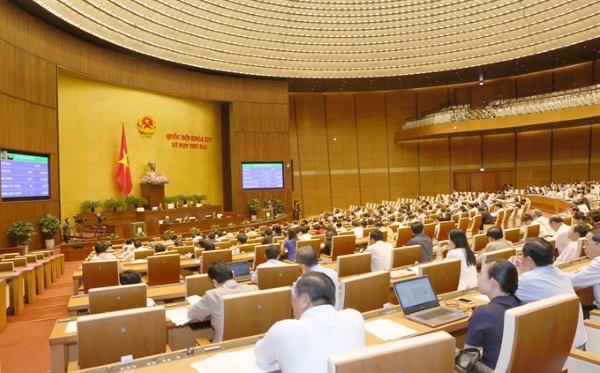
Law on Belief and Religion was passed during 14th National Assembly in the second session November 18, 2016 sitting
The necessity to build the amended Law on Belief and Religion
Vietnam is a multi-faith country. The Vietnamese government has consistently implemented a policy of respecting and ensuring freedom of belief and religion for all people, ensuring that all religions are equal before the law. The country currently has 40 organizations belonging to 16 religions that are recognized and licensed to operate, with approximately 27,382,846 lay followers, 66,365 religious dignitaries, 120,475 deacons, 30,374 religious establishments, and over 70,000 belief facilities.
The renovation initiated and led by the Party in recent years has profoundly transformed all aspects of social life, including religious life: The return of religious beliefs; the increase in the number of religious dignitaries, deacons, and lay followers of religious organizations; many religious activities taking place on a large scale, attracting a large number of followers and people to participate; religious organizations implementing the direction of practicing religion closely and accompanying the nation... Religious activities have addressed the needs of the masses and practically contributed to social life.
However, besides that, religious activities also reveal some limitations: the revival and development of many types of spontaneous beliefs that are not yet managed by the state; some deviant and anti-cultural religious and belief activities; the commercialization of religious and belief activities; the emergence of new religious and belief phenomena, organizations, and groups bearing the name of religions, beliefs, new religions, strange religions...

Vietnam is a multi-faith country
From this reality, it is necessary to improve the law on belief and religion at the present time to better ensure freedom of belief and religion for the legitimate interests of the community of believers and religious organizations, as well as for the common interests of the whole society in the context of Vietnam promoting international integration, stemming from the following basic reasons:
Firstly, continuing to perfect the law on belief and religion aligns with the spirit of the Party's resolutions.
Second, the implementation of the two-level local government organization model in recent times has significantly impacted the organization and operation of religious organizations in Vietnam, as well as the state management of beliefs and religions, and has strongly influenced the law on beliefs and religions. Therefore, it is urgent to amend and supplement the provisions of the law on beliefs and religions in the direction of organizing two-level local governments and to resolve issues arising from the transition from the three-level local government model to the two-level local government model.
Third, science and technology, innovations associated with the Fourth Industrial Revolution, especially digital technology, are developing rapidly and significantly, creating breakthroughs in many fields, including the fields of beliefs and religions. Religions and religious organizations have been using information technology and cyberspace to propagate doctrines, organize religious activities, and connect with their communities and followers. Belief and religious activities in cyberspace have had a significant impact, creating both opportunities and challenges for the work of building and perfecting laws on beliefs and religions in Vietnam today.
Along with that, a number of laws were issued, amended, or supplemented related to religious and belief activities in the network environment, administrative procedure reform and digital transformation, such as: the Law on Cyber Security No.24/2018/QH14, the Law on Network Information Security No.86/2015/QH13 (amended and supplemented by Law No. 35/2018/QH14), the Law on Electronic Transactions No. 20/2023/QH15... requiring research to amend and supplement the provisions of the Law on Belief and Religion to ensure consistency with the legal system.
Fourth, the Law on Belief and Religion was promulgated in 2016, when Vietnam's socio-economic conditions and the world and regional situation were much different from the present. After 8 years of implementing the Law, its provisions have created favorable conditions for religious organizations and individuals to exercise their freedom of belief and religion, while also facilitating state management of belief and religion.

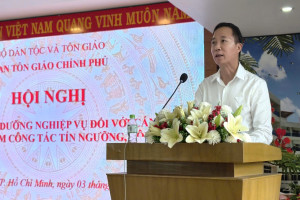
Deputy Minister of Ethnic and Religious Affairs Nguyễn Hải Trung chaired conference on November 26, 2025 to collect public opinions on the draft amended Law on Belief and Religion
Expected contents to be included in the amended Law on Belief and Religion
The Law on Belief and Religion (Amended) should focus on the following orientations:
Firstly, it is necessary to enhance regulations related to religious activities and beliefs in cyberspace.
When supplementing these regulations, first of all, it is necessary to affirm the rights of individuals and organizations to carry out religious activities in cyberspace. In addition, individuals and organizations, when carrying out religious activities in cyberspace, must comply with the principles and fulfill specific responsibilities according to regulations. Competent state agencies, based on their functions and tasks, are responsible for preventing content that violates the law on religion and belief.
Second, enhance regulations on decentralization and delegation to ensure freedom of belief and religion for everyone, while improving state management measures in the field of belief and religion.
Strengthen decentralization and delegation in the spirit of central resolutions and the Law on the Organization of Local Government 2025.
Supplementing regulations on the registration of belief activities outside belief establishments aims to expand the registration of belief activities to other organizations and individuals (such as private establishments, establishments invested in and built by enterprises with worshiping activities, etc.).
Supplementing contents related to the registration of appointed, elected, and nominated officials at religious organizations, affiliated religious organizations, and organizations granted certificates of registration for religious activities (accordingly, if appointing or electing officials, registration will be made in advance; if electing officials, registration will be made after the results are available); supplementing the subject of opening religious training classes as organizations granted certificates of registration for religious activities; supplementing regulations that organizations granted certificates of registration for religious activities are allowed to invite Vietnamese people to be dignitaries for foreign religious organizations to preach for the organization; supplementing the subjects that are allowed to carry out publishing, production, export, import of cultural products, and carry out educational, medical, social protection, and humanitarian activities as religious organizations and affiliated religious organizations; supplementing regulations on conditions for foreigners legally residing in Vietnam to register for concentrated religious practice groups...
Supplementing a number of measures of a warning, advisory, deterrent, and preventive nature to prevent religious dignitaries, officials, monks, some groups of religious activities, and organizations granted certificates of registration for religious activities from not performing religious activities for 6 months (for groups of religious activities), or from not performing religious activities for 12 months (for organizations granted certificates of registration for religious activities). Then, the document approving religious activities and religious activities of the competent state agency will cease to be valid. Supplementing regulations that if groups (including religious groups of foreigners legally residing in Vietnam) and organizations granted certificates of registration for religious activities do not comply with the provisions of law on beliefs and religions or violate regulations, their approval documents or certificates may be revoked.
Third, simplify administrative procedures and promote digital transformation in the field of beliefs and religions.
Simplify administrative procedures by inheriting existing administrative procedures as stipulated in the current Law on Belief and Religion (without creating new administrative procedures). At the same time, review and eliminate regulations related to reducing dossier components (such as criminal records of Vietnamese citizens and foreigners residing in Vietnam for more than 6 consecutive months); remove regulations on dossier components and the time limit for performing procedures in the Law, assigning the Government to stipulate detailed regulations in accordance with the organization of two-level local governments.
In addition, it is necessary to promote digital transformation in state management of beliefs and religions to contribute to building a digital government, aimed at developing a modern, transparent, and effective digital governance, while ensuring information security and protecting the personal data rights of individuals engaged in belief and religious activities.
Linh Nguyen